
It's Good to Talk
The phone networks are absent from the biggest cultural conversation of the decade.

Still from Orange TV ad
Walk into any Starbucks in America on a Tuesday morning, and there are, at a rough count, about forty people in the room, and the overwhelming majority are doing the same thing: heads down, thumbs moving, eyes locked on a glowing rectangle.
Starbucks, incidentally, declares its mission as “nurturing the human spirit, one person, one cup and one neighbourhood at a time.”
In this Starbucks, on this Tuesday morning, nobody is nurturing anything.
Zoom out to Christmas morning.
A friend travels across the country to see his family. Instead of the usual multigenerational chaos, he texts: “They were just absorbed in their phones a lot of the time, and distant.”
He is not talking about the kids.
He is talking about the grandparents.
The phone-based childhood, the subject of a decade of cultural panic, has now been joined by something nobody anticipated: the phone-based retirement.
Running between them, through every age and demographic like a fault line, is one of the most serious public health crises of the century.
And the companies best placed to address it are spending their energy on celebrity advertising wars.
Verizon, AT&T, and T-Mobile collectively generate over $400 billion in annual revenue.
They spend hundreds of millions of dollars each year on advertising that talks, almost without exception, about connection.
About family. About being there. About the moments that matter.
And then they do nothing to help those moments happen.
The Epidemic
In May 2023, US Surgeon General Vivek Murthy declared loneliness a national epidemic.
The numbers behind it are stark.
According to the American Psychiatric Association, 30% of American adults feel lonely at least once a week; 10% feel lonely every single day.
In 2024, 17% of Americans reported having no friends at all, up from 1% in 1990. That is not a rounding error.
The crisis spans every demographic.
AARP research from December 2025 found 4 in 10 Americans over 45 are lonely, up from 35% in 2018.
The WHO, in a landmark June 2025 report, found that one in six people worldwide is affected by loneliness, contributing to 871,000 deaths a year.
A 2023 Gallup study found more than one in five people globally had felt lonely the previous day.
Loneliness raises the risk of stroke, heart disease, dementia, and premature death at rates comparable to smoking fifteen cigarettes a day.
In a 2024 Harvard survey asking Americans what they believe contributes most to loneliness, one answer beat work stress, family breakdown, and economic hardship.
Technology, said 73% of respondents.
The product being sold as the cure is the one most associated with the disease.
7 Hours
The average American now spends seven hours and four minutes per day on screens, nearly fifty minutes more than in 2013.
Americans spend five hours and sixteen minutes of that on their phones alone, a 14% increase from 2024.
Over half say they want to cut down.
They are using their phones more while wanting to use them less.
The design is not neutral.
It is engineered for exactly this outcome.
For teenagers, the numbers are more extreme.
Generation Z averages nine hours a day on screens; 41% of teens exceed eight hours, not including schoolwork.
The Pew Research Centre survey of 1,458 American teenagers, published in December 2025, found 75% use YouTube daily, and roughly a third are on at least one platform almost constantly.
Eileen Kennedy-Moore, a Princeton psychologist reviewing the findings, asked the question that cuts to the heart of it: “If they are on it almost constantly, what are they missing?”
American teenagers spend nearly two hours a day on TikTok alone, roughly 54 hours a month inside a single recommendation engine.
In early 2026, a trend called #Pingtok saw teenagers film and aestheticise drug use in soft-lit, visually curated formats.
As one content researcher observed: “When risky behaviour is framed in soft lighting and trending audio, it stops looking dangerous.”
It starts looking aspirational.
Algorithms do not distinguish between healthy engagement and harmful engagement.
CDC data links higher screen time to significantly greater rates of teenage anxiety, depression, sleep disruption, and reduced social support.
Research in JAMA Psychiatry found that adolescents spending more than three hours daily on social media face heightened risks of suicidal ideation.
New York City’s teenagers, running on Verizon and AT&T towers, spend forty minutes more per day on their phones than their counterparts in Paris.
The Loop
The relationship between screen time and loneliness is a feedback loop, not a simple cause and effect.
A nine-year longitudinal study from Baylor University, tracking nearly 7,000 adults, found that both passive and active social media use are linked to increased loneliness and that lonely people are more likely to turn to social media, which makes them lonelier.
There is no natural exit.
A University of Pennsylvania study was the first to establish a causal link: participants who limited Facebook, Instagram, and Snapchat to ten minutes per platform per day showed significant reductions in loneliness and depression within three weeks.
Yale researchers add a useful nuance: screens are often a reasonable response to loneliness that has already taken hold.
People reach for their devices because they are already isolated.
The screen does not always create the problem; it deepens it.
If loneliness is a virus, excessive screen time is the fever.
It is worth pointing out that the science is contested.
A 2025 consensus survey of 229 psychology and neuroscience researchers found deep disagreement about whether smartphones drive anxiety and depression.
Jonathan Haidt’s influential work has serious critics.
But even the sceptics agree the loneliness epidemic is real and worsening.
The argument for phone network intervention does not require screens to be the primary villain. It requires only that a crisis exists, that the networks are primary beneficiaries, and that they’ve done nothing about it.
The Most Dependable Network for Avoiding Human Connection
The phone networks have never had to confront the fact that their entire brand proposition is built on connection, but their business model depends on disconnection. More data consumed means more revenue. Maximising screen time is not a side effect of their strategy. It is the strategy.
That is worth sitting with. These are not passive infrastructure companies, indifferent to what flows through their pipes. They have built some of the most emotionally sophisticated advertising in American commerce — campaigns about grandparents and grandchildren, about being there, about the moments that matter. They know exactly what connection means to people. They have just never had to reckon with what their product does to it. The platforms have been dragged into court. The algorithms are under legislation. The phone networks, which carry all of it and profit from all of it, have so far escaped that reckoning entirely. Not because they are innocent. Because nobody has thought to ask.
Their social responsibility programmes confirm the gap.
Verizon’s focus is digital inclusion, disaster preparedness, and STEM education.
AT&T’s 2024 community work involved backpacks with school supplies, e-waste recycling, and sports court refurbishment.
Worthy enough.
But none of it touches the most pressing social crisis of the decade.
In 2024, Verizon’s VP of Marketing admitted openly that “there is a lack of emotional connection to consumers” across the entire telecom sector.
His solution was a new logo.
Meanwhile, everyone else is being forced to act.
In 2026, TikTok, Meta, and YouTube face legal scrutiny over addictive design.
The European Commission has cited infinite scroll and autoplay as intentionally addictive under the Digital Services Act.
Australia became the first country to bar under-16s from social media entirely.
TikTok has introduced a default 60-minute daily limit for minors; bypassable, but revealing.
As one analyst put it: “The fact that platforms are pre-setting limits tells you the industry recognises a problem. We’ve moved from debating whether there’s an issue to debating how big it is.”
Governments are acting.
Platforms are being dragged into accountability. The phone networks that carry all of it have said nothing.
Meanwhile, their advertising departments are at war. AT&T, T-Mobile, and Verizon are locked in a litigation-threatening celebrity battle, each is taking shots at the other’s reliability statistics.
The only memorable thing, as one industry CEO noted, is the celebrity.
The brands are interchangeable.
This is the state of telecom ambition in the middle of a public health emergency.
What Could They Do?
The sociologist Ray Oldenburg spent decades documenting what he called the “third place”: the spaces outside home and work where community forms organically. The pub. The barbershop. The park bench. The diner counter.
His latest edition, updated in 2025, frames the third place as the answer to loneliness, political polarisation, and social fragmentation.
The phone network that positions itself as the infrastructure of third places — one that sponsors, convenes, and invests in the spaces where people actually gather — would occupy a cultural territory no competitor is anywhere near.
Consider a Verizon partnership with Starbucks for a monthly Phone-Free Thursday. Not a wellness lecture. Not another app.
In Fleabag, Phoebe Waller-Bridge’s character works in a café that designates certain tables as ‘chatty tables’ — seats where strangers are implicitly invited to talk to each other. It is a tiny structural intervention. It changes everything about the room.
That is the entire idea. Designate one morning a month across thousands of Starbucks locations as a screen-free zone. Put something on the table that signals permission, a conversation prompt, a simple card, anything that says: this is a room where talking to strangers is allowed. The Tuesday morning from the opening of this piece, the one where nobody is nurturing anything, looks different. Not because anyone was told to put their phone away. Because the room told them something different was possible here.
Or partnerships with museums, community gardens, beach clean-ups, food banks — spaces where the phone network becomes the organisation behind getting people into the same room. Not to use their devices. To put them away.
Nobody Waited
While the phone networks have been silent, a movement has been building without them.
It does not have a single name or a central organisation.
It has no major corporate sponsor, no national infrastructure, no billion-dollar advertising budget.
What it has is momentum and a generation of Americans who have decided, quietly and in growing numbers, that they would rather be in the room than on the feed.
The data is striking.
Eventbrite’s January 2026 “Reset to Real” report found that 79% of Americans aged 18 to 35 plan to attend more in-person events this year. 89% want events that connect them to their local community. 74% say in-person experiences are now more important to them than digital ones. 46% of Gen Z are actively limiting their screen time.
These are not the numbers of a fringe movement. They are the numbers of a generation making a deliberate turn.
Some of it shows up in the most unexpected places.
Book club listings on Eventbrite are up 24% year-on-year. Flower arranging events have grown by 282%. Puzzle competitions have doubled. Over 600,000 Americans attended block parties last year. These are not coincidences. They are the same impulse expressed in different rooms.
Social infrastructure is being rebuilt from scratch.
Build IRL, a San Francisco organisation supporting the social club movement, has run more than 50 events, distributed $50,000 in microgrants to community clubs, and supported over 10,000 hours of in-person gathering.
Timeleft, which organises Wednesday dinners for strangers based on algorithmic matching, is operating in dozens of American cities.
The Rooms That Work
The clearest evidence of what becomes possible when phones leave the picture is not in a survey. It is in the rooms where it has already happened.
In New York, San Diego, and San Francisco, an event organiser named Randy Ginsburg has been running Kanso: curated, phone-free social gatherings where guests check their devices into lockers at the door.
Ginsburg has since expanded to phone-free live music in San Diego under the name Kanso Unplugged.
In Washington D.C., Vox reported in November 2025 on a social club using a local bar as its regular home for phone-free evenings.
In the live music world, the shift is more visible still.
Lane 8, the Colorado-based electronic producer who has run his “This Never Happened” tour on a strict no-phones policy since 2018, has described what the rooms felt like before and after. “I noticed whenever I played one of my better-known tracks,” he wrote, “instead of it being a real moment in the set, everyone was just standing there with their cell phones recording.”
After implementing the policy tape over the cameras at the door, and security watching the crowd the results were, by his account, transformative. “The interaction between audience members, the connections to the music, and the reaction to those moments, has been overwhelming. As a performer, I have never experienced anything like it.”
He started the idea in San Francisco. “There were some nerves about whether we could pull it off,” he said, “especially in San Francisco, which is like the tech capital of the world. But it was the best show we’d ever done. People were self-policing. If someone whipped their phone out, people within the crowd were telling them off.”
Fred Again, the British producer with 20 million monthly Spotify listeners, brought phone-free experiences to America at scale in late 2025 and early 2026. His USB002 tour ran ten shows across ten cities in ten weeks, each with a sticker placed over phone cameras at the door.
The six-night January 2026 residency at East End Studios in Woodside, Queens, was the first series of concerts at the newly opened venue. The official FAQ stated the policy plainly: “We will provide a sticker at entry, to cover your phone cameras so everyone can stay in the moment.”
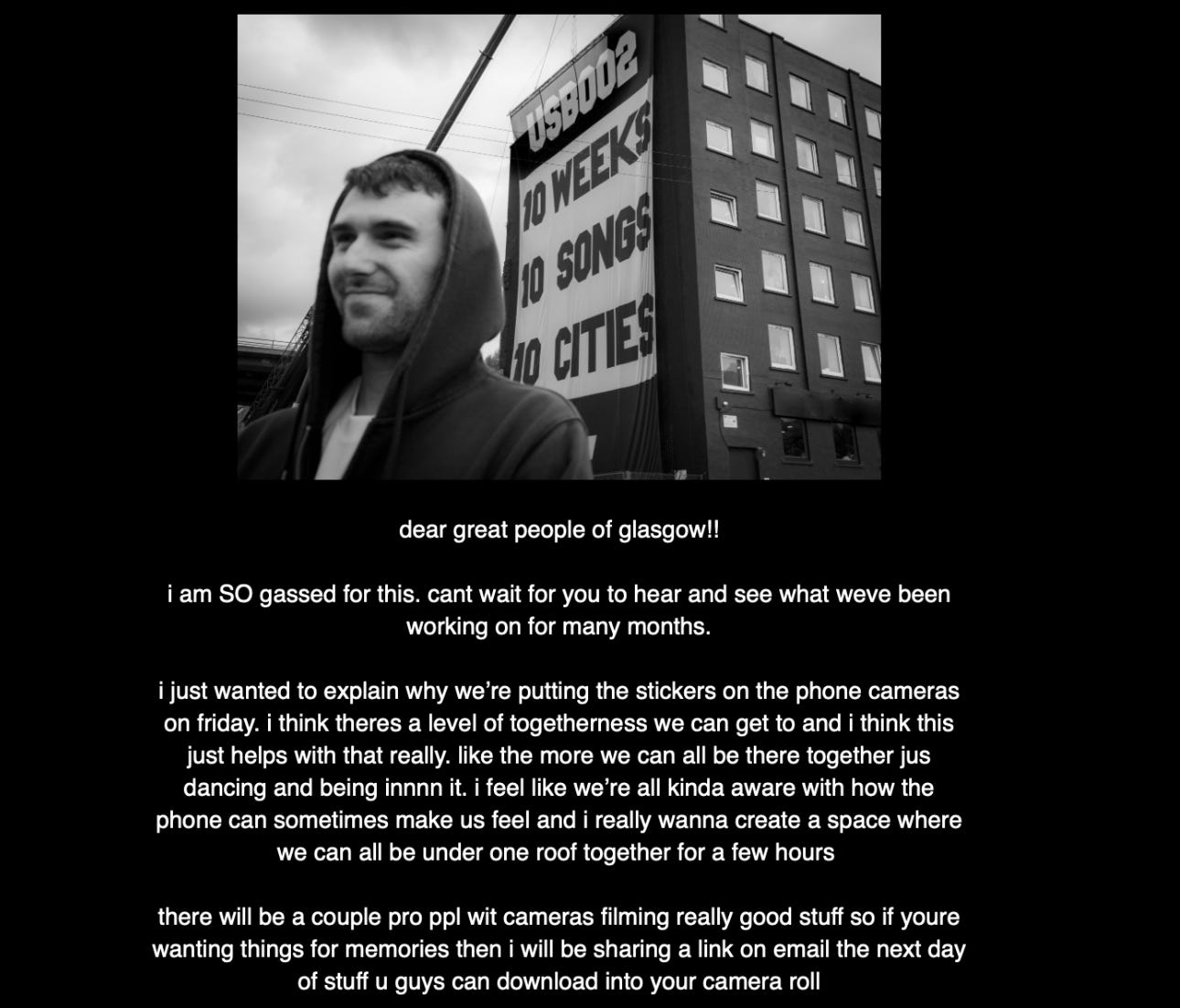
Fred explains the stickers
A reviewer at the San Francisco stop described what the sticker produced, even if imperfectly enforced: “A good portion of the room peeled them off, but the mere presence of the sticker worked like a moral compass. People still filmed, but quietly, maybe fearfully. Ten seconds, and then a panic shove into the pocket. Somehow, that collective low-stakes guilt created the best dance floor I’ve seen — at this scale and popularity — in years.”
The sticker did not need to be enforced. It just needed to exist.
What is notable about Fred Again is not just the policy but the paradox. This is an artist who built his entire career through the internet, who built community through platforms, who used TikTok and Instagram to reach millions. He then deliberately engineered spaces where the internet disappears. Speaking to Nardwuar in one of his rare interviews, he described an Underworld show he attended with Skrillex where phones were absent from the crowd. “Sonny walked in and was like: ‘This is the rarest crowd dynamic I’ve seen in years.’ Phoneless, present, in it, it was all feeling loose in the best possible way.”
Sofar Sounds, founded in a London living room in 2009, now operates in 78 countries and has paid artists over $30 million since the pandemic. Its shows happen in apartments, rooftops, galleries, and parks across America. Attendees do not know who they are seeing until they arrive. The intimacy is the product.
Co-founder Rafe Offer described the moment it became a movement: “People started calling from other cities saying they wanted to host events there too.”
Yondr, the company that makes lockable phone pouches, has secured over 20 million devices at more than 10,000 events across 27 countries. Dave Chappelle, Paul McCartney, Jon Stewart, Erykah Badu: made it mandatory.
Broadway productions are adopting it.
The company exists because the demand to be present — to be in a room without the option of leaving it digitally — has proven large enough to sustain a business.
Kyle Chayka, the New Yorker technology writer who spent three and a half months on an algorithm cleanse, described what happened when he stopped. He went to art museums. He dug into jazz back catalogues.
And he started actually talking to friends, asking what they were reading, noticing, paying attention to. “When I got off the feeds, it pushed me to talk to my friends about what they were consuming.”
Somewhere in that story is the entire brief for what a phone network with ambition could build.
The Standard Already Exists
Orange. The British phone network’s early-2000s campaign — built around “The Future’s Bright, The Future’s Orange” became one of the most celebrated pieces of advertising of its era. Its most famous execution, the New York Blackout spot, had nothing to do with selling mobile contracts.
Orange wasn’t advertising a product. It was advertising a feeling. A world view. A disposition toward life.
The telecoms industry has abandoned that territory entirely. The companies that sell the tools of human communication have stopped communicating anything worth listening to. The cultural moment they have been waiting for — the one that would give them the emotional resonance their advertising has spent decades pretending to have — is sitting right in front of them. Unclaimed.
The loneliness epidemic is not going away. The zenith of the cultural moment is right now.
The question is whether any of these companies is capable of seeing what is directly in front of them.
The brands most positioned to own this moment are the ones most practised at looking away.
And moments like this do not wait.
Sources: American Psychiatric Association Healthy Minds Monthly Poll, 2024 · Harvard Making Caring Common Project, 2024 · WHO Commission on Social Connection, June 2025 · Gallup Global Emotions Report, 2023 · CDC National Health Interview Survey – Teen, 2021–2023 · Pew Research Center, December 2025 · Baylor University, Personality and Social Psychology Bulletin, 2025 · Hunt et al., Journal of Social and Clinical Psychology, 2018 · AARP Research, December 2025 · Harmony Healthcare IT, 2025 · Strava Year in Sport, 2025 · Hootsuite Social Trends, 2024 · Oldenburg & Christensen, The Great Good Place, 2025 · David Bowen, Verizon, Campaign US, June 2024 · Charlie Warzel, The Atlantic, December 2025 · Kyle Chayka, The New Yorker, July 2025; GQ, January 2024 · Jordan McMahon, New York Magazine, September 2025 · Van Bavel & Capraro, 2025 · The Marketing Heaven, February 2026 · Eileen Kennedy-Moore, Princeton · Ipsit Vahia, McLean Hospital · Kenneth Schlenker, Opal · Yondr · Eventbrite Reset to Real Report, January 2026 · Lane 8, Vice, 2016; EDM.com, 2025 · Fred Again, Nardwuar Interview, October 2024 · Maddy Mussen, Evening Standard, February 2026 · Build IRL, 2026 · Sofar Sounds
It’s so good to talk! And, I now know of 229 psychology and neuroscience researchers who need to get their heads out of their arssess.
I was working in a bookstore for a while and basically all of my coworkers had flip phones, which was the first time I had seen so many first hand.
This felt to me like a particularly concentrated subset of the population (bookstore workers tend to be weird, leftist, and obsessed with physical media) designed strongly against the ills of social media. One of them had even been a massively followed Twitter user who burned out hard and found life majority post internet to be much more fulfilling.
But I wonder if this kind of view could ever be strong enough to create economic impact? The tendency towards more Luddite behavior feels strong momentarily but never sustainable, and points to why products like Yondr at concerts or Brick at home have been so successful. Do they have any lasting staying power? Or is this another fad when the pendulum briefly swings the other way? Sometimes scrolling through anything I’m struck with the feeling of “who is this for?”
Can the relationship with these things improve? Are we built for moderation? Do they allow us, even, to be moderate when the algorithms and UX’s are so built for addiction?
And how does the third space shift when people, likely driven by social media in another way, are hyper fixated on health? What does socializing look like in cities when you don’t drink at a bar?
In a similar vein, the value proposition of a city is trading space for access to people, restaurants, events, work, etc, but when we become more atomized they feel remarkably built for loneliness rather than community.