
Diplomatic Luxuries
France's "Hidden Treasures" At The Shed

Almost unannounced, 65 shipping crates arrived from France and took over the top floor of The Shed, Manhattan’s striking architectural venue nestled right beside the High Line vertical garden.
Each crate represented a single French luxury Maison, and each contained a unique story that connected said Maison to the United States.
It was a masterclass in soft power.
Last year, amid escalating tariff disputes, France’s luxury brands found themselves facing a 15% tariff on wares sold in the United States.
In response, these crates were dispatched with a specific mission: to chronicle their 250-year-old love affair with America and its people throughout the country’s history.
The Art of Subtle Storytelling
Inside the gallery, the collection of brands offered an extraordinary tapestry of narratives.
Christofle showcased the exquisite dinner sets that were standard issue on glamorous 1930s transatlantic ocean liners.
Hennessy traced its lineage directly back to the signing of the Declaration of Independence.

Cartier’s gold Apollo lunar lander
Jean Paul Gaultier reminded visitors of its iconic alliance with Madonna in the early fight against AIDS.
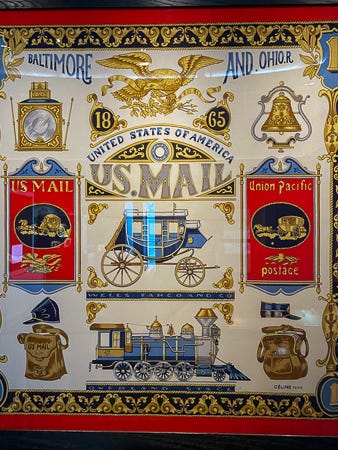
Celine US Mail silk scarf.
Lancôme leaned into recent nostalgia, displaying a classic advertisement with Julia Roberts’ unmistakable smile.
There was nothing flashy here, zero AI, no holographic gimmicks, and no giant LED screens.
Instead, the exhibition was stealthy, elegant, and understated.
It was designed to be absorbed collectively as an overarching experience with a single, unmissable message: France’s luxury creators share deep, historic roots with America.
Courting the Chattering Classes
This was not an exhibition engineered for mass consumption; it was no art blockbuster at the Metropolitan Museum or a Museum of Ice Cream- Instagram fest, rather, it was a targeted message aimed squarely at coastal elites, tastemakers, and expats, designed specifically to get the chattering classes talking about French luxury.
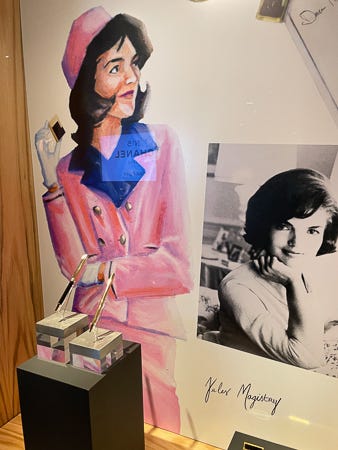
The most dominant figure to emerge from the showcase was Jacqueline Kennedy, with multiple brands anchoring their histories around her legacy. It was a natural fit. Jackie possessed French ancestry, spoke the language fluently, and had studied in France. Most significantly, she remains an eternal style icon, having famously worn Givenchy, Balenciaga, and Chanel.
A Political Liability: Interestingly, Jackie’s “Frenchness” was initially viewed as a liability by political strategists. They worried it would alienate middle-class voters accustomed to a more traditional style of First Lady, and political opponents frequently targeted her penchant for French designers.
The Bottom Line
The 65 crates belong to the members of the Comité Colbert, the official association of French luxury practitioners.
15% tariffs imposed by the US on French imports, which increase to 50% on certain items containing metal components, are making a tangible impact of their own.
According to research conducted by the Comité Colbert:
61% of Americans still consider French products worth buying.
46% state that their perception of French brands remains unchanged despite the trade tensions.
The Risk: Conversely, the study warns that if prices rise by 15%, only 27% of American consumers would consider French products to be worth it.
Ultimately, the Comité Colbert and its member Maisons are wagering that if the chattering classes chatter loudly enough, the message will echo all the way to the White House, perhaps convincing the administration to grant a waiver on that 15% tariff.
If they succeed, this quiet, elegant strategy, together with its 65 crates, will have paid for itself several times over.